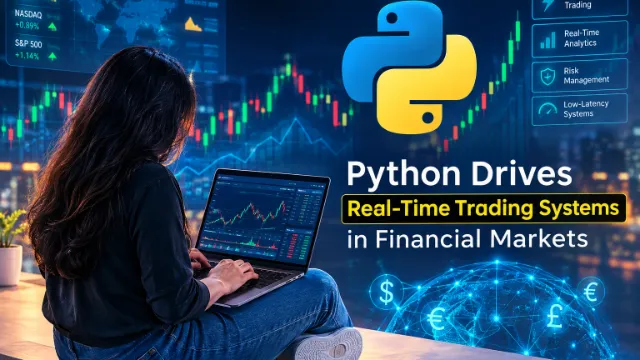
How Python Drives Real-Time Trading Systems in Financial Markets
The speed of action in financial markets is truly staggering. Price changes happen in milliseconds, orders get executed virtually instantaneously, and even a tiny delay can be sufficient to lose the chance to make a profit from an otherwise promising situation. The underlying technology which enables such pace of action comprises a unique set of data, math, hardware and software. One of those technological solutions which have influenced this environment is Python algorithmic trading.
In research and development, risk management, and live trading operations, Python helps financial organizations, quantitative analysts, and individual traders construct better Python trading systems.
Why Python Is a Favorite in Algorithmic Trading
Trading systems must process massive volumes of data when making decisions according to pre-established rules. Historically, efficient financial programs have been implemented using C++ and Java. However, now Python is used increasingly more in research due to its simple syntax and excellent eco-system.
The true power of Python-based algorithmic trading comes from the ability to perform any actions using just one language. The trader can process market data, compute technical indicators, construct models, backtest the strategy, plot graphs, and use trading APIs without jumping between several different programming environments.
NumPy, pandas, SciPy, and machine learning packages are the libraries which allow constructing algorithms necessary for the conversion of market data into the decision-making process.
To sum up, implementing trading strategies with Python is not only about writing scripts for the buying and selling of assets. It is about building a whole workflow starting with the data.
From Market Data to Trading Decisions
Let us envision how a trade system works when receiving hundreds of thousands of price changes per second. It collects fresh data, processes it, analyzes the situation, and decides on whether it is time to place an order.
The following would be a common algorithm of a trade in Python:
Market Data → Data Processing → Strategy Engine → Risk Management → Order Execution → Monitoring
Python may be used in almost all of these steps.
Here, for instance, the strategy can watch for moving averages, volatility, trading volumes and momentum. If certain criteria are met, then a signal is generated by the strategy engine. And even before that signal gets to the market, risk-management rules will calculate position size and exposure limits.
This is the essence of modern trading automation pipelines.
Building and Testing Python Trading Strategies
One of the most valuable benefits of Python is the opportunity for fast experimentation.
It is possible to test the trading strategy on historical market data before applying it using any money. This technique is called backtesting and helps traders evaluate how their strategy will work in various market environments.
Thus, for example, there are many strategies that can be developed in Python according to the following methods:
- Moving average crossovers
- Momentum and mean reversion
- Statistical arbitrage
- Volatility patterns
- Market making
- Portfolio optimization
- Machine learning signals
However, it is crucial to mention that backtesting does not give any guarantees regarding the performance of the strategy in the future. A perfect strategy in terms of backtest results may fail in live trading due to transaction costs, slippage, changed market behavior, etc.
This is why successful Python-based trading strategies should include not only good backtests.
Also Read: Advanced Financial Frameworks: Building Strategies Around Market Uncertainty
Python Meets Real-Time Market Data
“Real-time” alters the engineering task.
Historical backtesting can analyze a dataset after the event is passed. A real trading application, on the other hand, needs to be able to react immediately to new events. Prices are coming in, orders are being filled, markets are changing, and the system needs to react without any delays.
Python can connect to market-data feed and brokerage API, so that the application could receive prices and send orders automatically. The developers also can implement an event-driven architecture, where incoming market events initiate certain parts of code.
For instance:
New price arrives → calculate indicators → check strategy → check risk → generate order → send order → confirm execution.
This method makes it possible for Algorithmic Trading with Python to go from backtesting to live trading applications.
Where Python Fits & Where It Doesn’t
Python is very powerful; however, it’s not a silver bullet to solve all problems in trading.
In many cases, Python is the perfect language due to the fact that, in order to perform some quantitative analysis, what is more important than execution speed is productivity of developers and analysis itself.
Yet there are special cases in which ultra-low latency trading is needed. In such situations, special software and hardware infrastructure might be necessary along with special programming languages.
However, this doesn’t mean that Python has nothing to do with such trading systems. Actually, there is another fundamental rule to be applied here: the right technology must be used for the right layer.
So, for example, a financial firm can use Python for research, portfolio management logic, analytics, monitoring and orchestration.
Python and Financial Technology
Python fintech development goes hand in hand with the development of finance in general. As financial organizations pursue digital transformation with Python developers, they can modernize legacy processes, integrate APIs and build more flexible financial applications.
In the context of modern fintech solutions, APIs of the market data, portfolio management, brokerages, payments, and analytics become more available. And Python can help programmers to integrate with such solutions and create tailor-made software.
Machine learning has become another aspect of the development of Python’s influence on financial activities. Using Python-powered solutions, financial teams can analyze the structure of the market data, classify data, assess risk, and even predict future trends.
But the good idea for trade will remain the key element of success despite all technological advances. No matter how good machine learning algorithms are, bad data, wrong assumptions, and poor risk management cannot be fixed by any algorithm.
Risk Management: The Unsung Hero
Any great trading algorithm is useless if it cannot manage risks.
Professional Python trading systems usually incorporate measures to protect against excessive positions, loss limits, monitoring of risk, verification of orders, and automatic shut-downs of a system.
Let us assume that our strategy has started creating too many orders due to some anomaly of the data input.
A robust system would be able to recognize abnormality and would not allow our strategy to create unlimited losses.
This is how real-time trading architecture should take into consideration opportunity as well as protection.
Our goal is not to trade fast, but to trade smartly.
The Future of Python for Algorithmic Trading
With further automation of financial markets, there will be an increasing need for software. In this respect, Python looks quite promising due to its capacity to connect research, analysis, machine learning and production.
Perhaps the future might witness the development of even more advanced systems which integrate live data feeds, adaptive models, alternative data sets and automatic portfolio decisions. In light of this, Python’s diverse ecosystem makes this language even more suitable for integration of different solutions.
Therefore, in terms of acquiring a coding skill, learning Python for algorithmic trading is not just about learning programming. Instead, it allows gaining knowledge on the working principles of data, quantitative models, APIs and automation.
Also Read: Analyzing Financial Statements for Stock Investment Decisions
Conclusion
Trading with Python is becoming more intelligent, swift, and automated than ever before. Algorithmic trading with Python makes it possible for programmers to create robust Python trading programs, analyze Python trading strategies, and assist in real-time market decision-making. Given the evolution of fintech, algorithmic trading with Python will continue to be practical and efficient.